A.J. Dreyer
Architect of a Boomtown
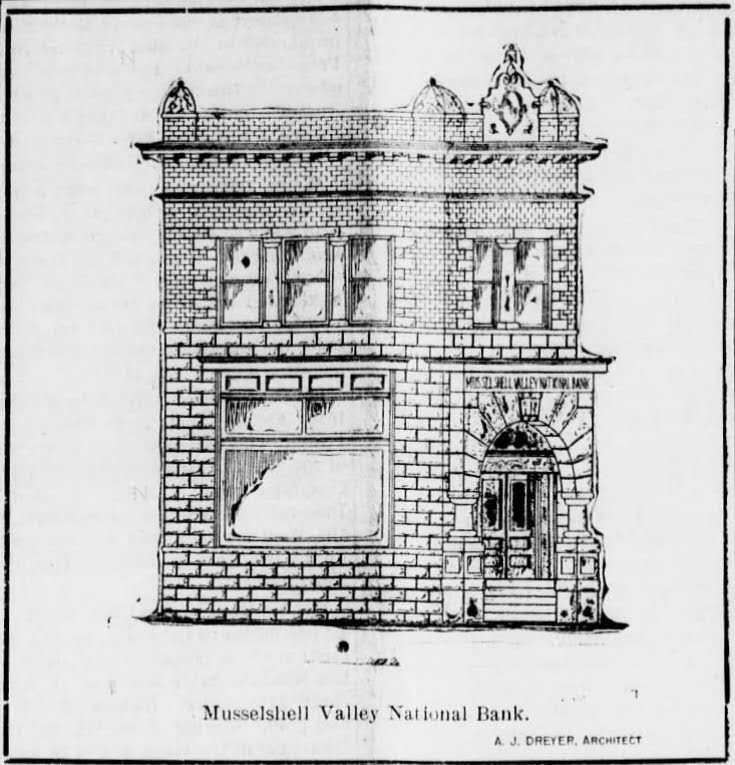
The Harlowton Press - Jul 23, 1909
Anthony Job "A.J." Dreyer called Harlowton home for a little over a decade — 1908 through 1921 — a time that was arguably part of the town's most promising years. Harlowton's population, boosted by the arrival of the Milwaukee Road, more than doubled during this time, peaking around 1920. Dreyer arrived as an immigrant tradesman with a cornet and drafting tools, and by the time he moved on, he had designed a meaningful share of the town's structures — storefronts, schools, churches, and homes — while also quickly throwing himself into its civic and cultural life. He took leadership of the town band, sat on committees for public works and Fourth of July celebrations, served as a lodge officer, helped organize the local baseball team and field, and held office in the movie theater company. He seems to have understood, from day one, that being an architect there meant being a citizen there too.
From Norway to the Prairie
Dreyer was born July 23, 1876, in Øksnes, Nordland, Norway, and emigrated to the United States as a young man. The years between his arrival and his appearance in Harlowton in 1908 are the least documented stretch of his life, but a few threads survive. He held roles as a painter, carpenter, and ranch hand in Glendive. He served as a cornetist while in the U.S. Army. He gave music lessons in Seattle. And, by his own account reported years later in the Ryegate Reporter, he spent "several years on the western coast," working independently and superintending construction of a number of large buildings in coastal cities — practical experience, it seems, well before he ever called himself an architect in print. A newspaper clipping from 1921 mentions a visit from Dreyer's "old classmate and friend, R. Sisson," by then superintendent of architectural engineering at the university in San Francisco and a consulting engineer for Standard Oil. While also handy with a hammer, this suggests Dreyer likely studied architectural engineering formally at some point during those pre-Harlowton years.
By September 1908, Dreyer and his family — his wife Martha and young daughter Marie — were living in Miles City, and the family soon relocated to the new railroad town of Harlowton, where Dreyer went into business, along with his brother, "putting in the new hardware store."
Arrival in Harlowton
Dreyer's name appears in the Harlowton papers almost immediately, and rarely for just one thing. He arrived as a partner in Stevens & Dreyer, "one of the most complete [hardware] stocks to be found in the state," according to the local press, while simultaneously advertising himself as an architect and builder, "Perspectives & Estimates furnished on any notice." Within weeks he had also taken over as instructor and reorganizer of the Harlowton band, one of many music-related roles he would embrace over the next decade.
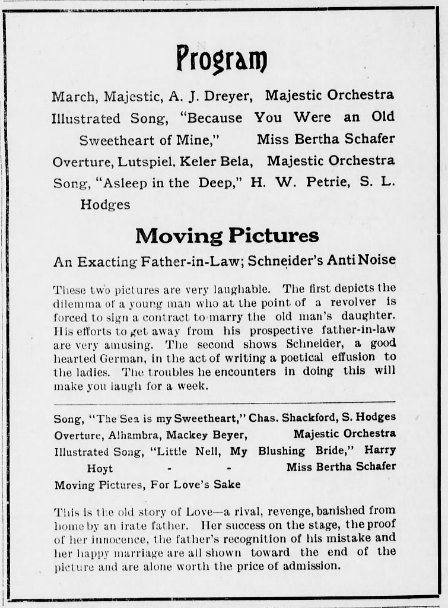
Majestic Theater playbill - 1909
In his first few years, he established himself as an architect and a community figure. He drew up plans for numerous structures including a number of churches (Methodist, Catholic), a saloon, a livery, residential homes, a second floor for the hardware store, and a stone commercial building for his brother's firm. The paper mentions him being "pleasant and accommodating" and "regarded by all as trustworthy as an architect." He rebuilt the town band from three musicians to sixteen, in part by helping recruit players and working with local businessmen to find them jobs. He served on a citizen's committee proposing a municipal water system, a fire department, a baseball team and field, and became treasurer of "The Majestic," the new movie theater and vaudeville house — for which he organized music and performed with the house orchestra.
Loss and Rebuilding
Not every chapter of these years was triumphant. In May 1910, Dreyer's wife Martha died in Lewistown at age twenty-three, weeks after giving birth to their second daughter, also named Martha. The paper suggests Dreyer stepped back from public life, if only briefly, to grieve and to care for two young daughters.
He did not stay away from either music or building for long, and by October 1910 he had left the hardware business entirely to return to architecture full-time, taking an office in the Graves building and returning to his homestead six miles from Harlo, describing himself as a believer in the "back to the farm movement." In August 1913, he married Amanda Alberta Peterson in Davenport, Iowa, and the couple returned to make their home in Harlowton. Together they would go on to raise five more children: Thelma (1914–2008), Helen (1916–2015), Anthony Julian (1917–1994), Philip Louis (1920–2003), and Theodore Elliott (1927–2008).
The Working Architect
By 1912, Dreyer had established a name for himself in the region. He was awarded the design for the Ryegate school — designing the style, drawing up plans, and supervising the construction. It launched a steady stream of institutional work across the region: schools at Shawmut, Lennep, Twodot, in the Oka district, and at the Nihill school; a Norwegian Lutheran church at Lennep - built by Thomas E. Sorboe - a fitting commission, given his own Norwegian roots; a hotel at Ryegate; the Martinsdale Bank; and, in Harlowton itself, the Wheatland County Jail and the Martin & Jones business block (The Montana Building), which still stands today, adjacent to the museum.
By 1915, Dreyer was attending statewide meetings of architects in Helena discussing a proposed licensure law, and by 1917 ads in the local paper identified him as a licensed architect and member of the Montana Association of Architects — confirmation that the professionalization he'd helped discuss in 1915 had taken hold, and that he was now formally credentialed.
Answering the Call: WWI Shipyards (1917–1919)
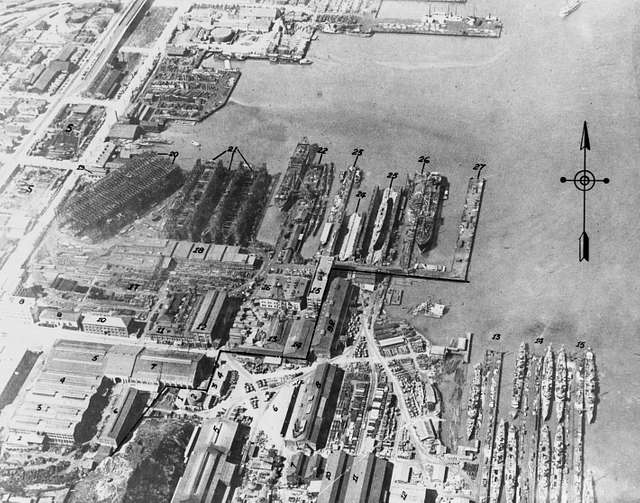
Union Iron Works - San Francisco - circa 1918
In early September 1917, at the height of what the local paper described as "a lucrative business" in Harlowton, Dreyer answered a U.S. government call for skilled tradesmen and left for San Francisco to help build ships for the war effort. The local press framed it in patriotic terms, comparing the volunteer tradesmen's sense of duty to that of soldiers enlisting outright. Friends gathered for a farewell reception at the Eastern Star lodge hall before Dreyer and Amanda departed together for their relocation.
Dreyer spent nearly two years on the coast, working as an architectural draftsman in western shipbuilding plants through the November 1918 armistice, then briefly as an engineering architect for a large corporation, before he and Amanda returned to Harlowton in 1919 to make it their home again. He came back with a variety of residence plans and a new specialty in concrete construction — a skill that would inform some of his postwar work.
Post-War and Portland
Upon return from the war, Dreyer's services were in high demand. By 1920, the local paper reported he had more than $200,000 worth of plans drawn up for regional projects contemplated for the coming spring — a notable figure for a small-town architect. He opened a branch office in White Sulphur Springs, was awarded the Rapelje school contract, surveyed and laid out a new Catholic cemetery, and produced detailed maps of Wheatland County including "each town in the county, school districts, roads, oil drilling sites, etc." Dreyer relocated to Helena in 1922 and later to Portland, Oregon, in 1926.
In Portland, area newspapers show Dreyer active as an engineer for the county. He was mentioned professionally for: plans for increasing the space in the courthouse; a beach front home; plans for a horse track, grandstand, clubhouse, and stables; the Rocky Butte jail; a new home for his family; a treatment center for delinquent youth; a county cemetery administration building; and a Lutheran "home for the aged." His most significant known project from this period is the Rocky Butte Scenic Drive, a Multnomah County WPA-era park road completed in 1939, where county records credit him as the engineer overseeing its construction alongside masonry superintendent Ralph Curcio. In Portland, Dreyer was active in the Shrine and Elks lodges and Portland Lodge No. 263 S.F.A.
Legacy
Dreyer would go on to spend more than three decades in Portland — rising to county engineer, overseeing projects like the Rocky Butte Scenic Drive, and remaining active in community life until his death in 1962 — but it was in Harlowton that he first built a career from the ground up. Looking back at those years, what stands out is not just the volume of buildings he left behind, scattered across the Musselshell Valley and beyond, but how completely he wove himself into the life of a town that, for a brief span in the early twentieth century, was one of the most promising places in central Montana. His involvement in local business, committees, lodges and fraternities, musical groups, and public projects paints a picture of a person who helped not only build the physical elements of a community but also contribute to its social fabric — a pattern he would go on to repeat, decades later, in Portland.
Sources: genealogical records, FamilySearch.org; The Harlowton Press; The Times Clarion; The Dawson County Review; Ranger Review; The Sunday Oregonian; The Oregonian; The Oregon Daily Journal; “Rocky Butte,” The Oregon Encyclopedia, Oregon Historical Society; and The Architect and Engineer, via archive.org.